Chicago Marathon Weather: Eight Race Mornings From 42 to 72 Degrees, and What to Wear
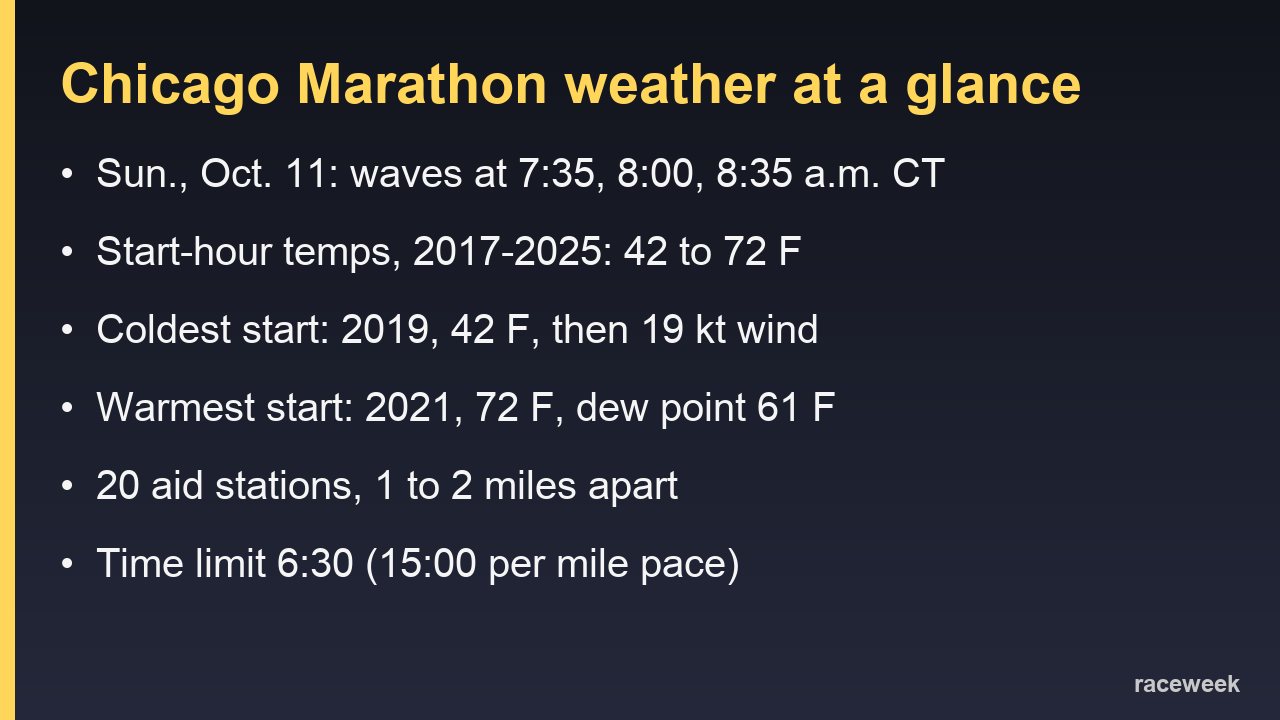
The short version — The Chicago Marathon is Sunday, Oct. 11, 2026. Wave 1 starts at 7:35 a.m. CT in Grant Park, Wave 2 at 8:00 and Wave 3 at 8:35. Over the last eight races, the 7:53 a.m. reading at Midway Airport has ranged from 42°F (2019) to 72°F (2021), so there is no "normal" Chicago race morning to pack for. Bring kit for both ends, and decide from the forecast in race week.
Chicago sells itself as flat and fast, and on a cool day it is: Kelvin Kiptum ran the course record, 2:00:35, in 2023 on a morning that went from 47 to 51°F while the leaders were running. On a warm day, the same course has no shade to speak of and no hills to slow the field down early. The weather decides more Chicago races than the course does, which is why this page is built around the hourly record, not a monthly average.
What time does the Chicago Marathon start in 2026?
| Sun., Oct. 11 (CT) | What happens |
|---|---|
| 5:30 a.m. | Grant Park, gear check and start corrals open |
| 7:20 a.m. | Wave 1 corrals close; men's pro wheelchair start |
| 7:30 a.m. | Professional men and women start |
| 7:35 a.m. | Wave 1 start |
| 7:45 / 8:00 a.m. | Wave 2 corrals close / Wave 2 start |
| 8:10 / 8:35 a.m. | Wave 3 corrals close / Wave 3 start |
| 4:00 p.m. | Gear check and the 27th Mile Post-Race Party close |
The one-hour gap between Wave 1 and Wave 3 matters for weather. A Wave 3 runner aiming for 5:00 finishes around 1:35 p.m., which on most of the years below is the warmest part of the day. The course limit is 6 hours 30 minutes, a 15:00-per-mile pace, tracked by a vehicle behind the last starter.
How warm or cold has Chicago Marathon morning been?
These are hourly observations from Chicago Midway Airport, an official NWS station about 9 miles southwest of Grant Park, pulled from the Iowa Environmental Mesonet archive. The lakefront can run a few degrees cooler with an east wind, and the open stretches feel a south or west wind more than an airport sensor does.
| Race day | 7:53 a.m. | Dew point | 10:53 a.m. | 12:53 p.m. | What it felt like |
|---|---|---|---|---|---|
| Oct. 12, 2025 | 52°F | 47°F | 62°F | 66°F | Clear, light wind, warm late |
| Oct. 13, 2024 | 60°F | 53°F | 61°F | 66°F | Mild, west wind to 18 kt by 2:53 p.m. |
| Oct. 8, 2023 | 47°F | 37°F | 53°F | 55°F | The record year: cool all day |
| Oct. 9, 2022 | 47°F | 32°F | 60°F | 67°F | Cold start, 20-degree climb |
| Oct. 10, 2021 | 72°F | 61°F | 75°F | 76°F | Humid and hot from the gun |
| Oct. 13, 2019 | 42°F | 32°F | 48°F | 53°F | Coldest; west wind to 19 kt by 10:53 |
| Oct. 7, 2018 | 59°F | 56°F | 60°F | 61°F | Overcast, drizzle until late morning |
| Oct. 8, 2017 | 57°F | 54°F | 69°F | 76°F | Sticky start, 76 by early afternoon |
Two patterns stand out. First, the start temperature is a poor guide to the finish: in 2022 the gun was 47°F and a 5-hour runner in Wave 3 crossed the line in the upper 60s. Second, the dew point tells you more than the thermometer. The 2018 race never got above 61, but a 56-degree dew point and drizzle made it feel heavier than that number suggests. FindMyMarathon's long-run race-date averages, a 46°F low and a 64°F high, sit right in the middle of this table, and only a couple of recent years actually looked like the average.
The extreme case is 2007. The temperature reached 88°F, organizers shut the course down after about three and a half hours, more than 10,000 registrants did not start and 10,934 did not finish. That day is why Chicago now runs a color-coded Event Alert System.
What should you wear for each kind of Chicago morning?
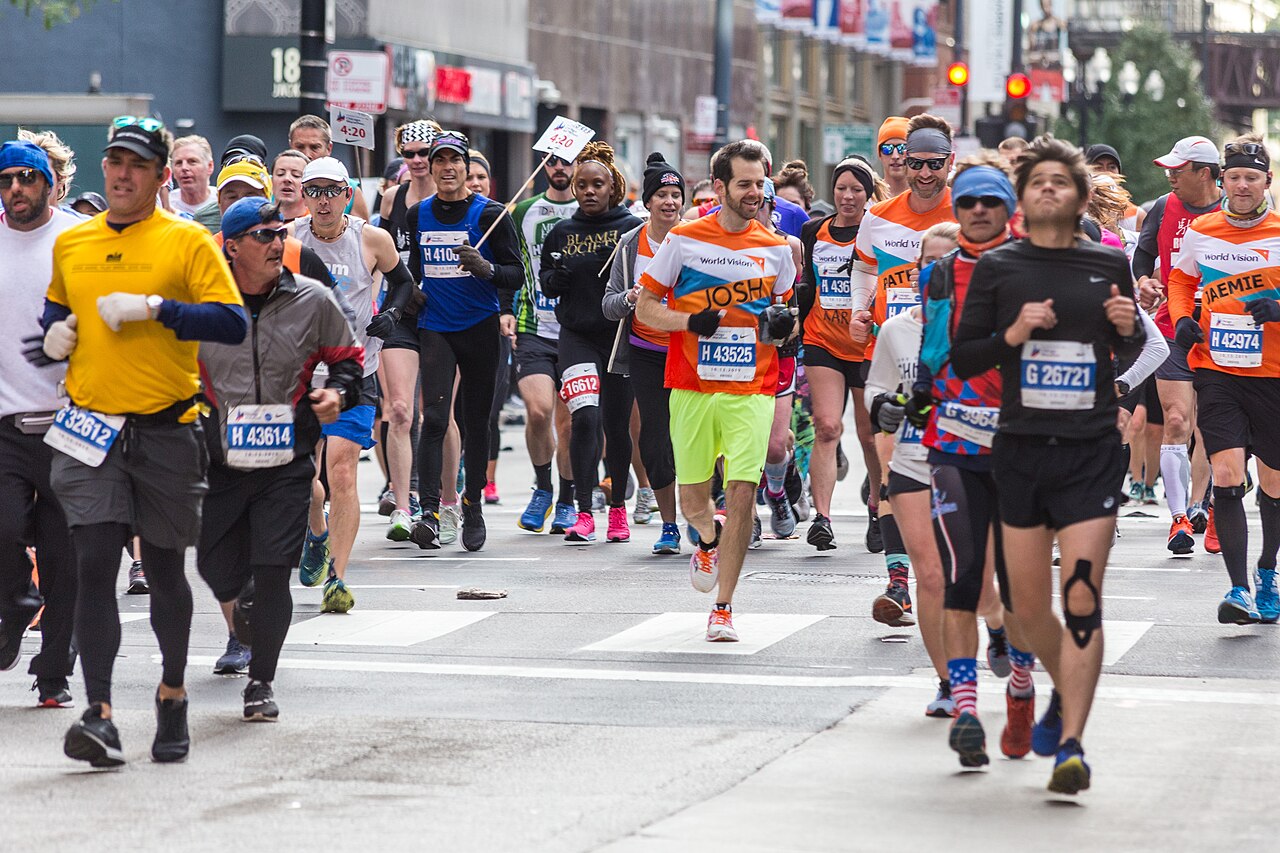
Dress for the temperature you will see at mile 13, not in the corral. For most runners that is 5 to 10 degrees warmer than the start reading. Using the years above as the three likely scripts:
| If the 7 a.m. forecast is | Like | Race kit | Corral layer |
|---|---|---|---|
| Below 45°F, windy | 2019 | Shorts or 3/4 tights, long sleeve or tee plus arm sleeves, thin gloves, a headband or cap | Throwaway sweatshirt and pants, a trash bag if it is windy |
| 45 to 55°F | 2022, 2023, 2025 | Shorts, singlet or tee, gloves you can shove in a pocket by mile 5 | Throwaway long sleeve |
| 55 to 65°F, humid | 2017, 2018, 2024 | Singlet, shorts, cap or visor; skip gloves | A cheap poncho if it is drizzling |
| 65°F or warmer | 2021 | Least fabric you are comfortable in, sunscreen, a cap you can soak | None beyond a trash bag for the wait |
Throwaways have a proper home here. The race asks runners to drop extra clothing in marked clothing collection zones near and inside the start corrals. Your gear check bag must be the clear plastic participant bag from the expo; no other bag is accepted, and gear check closes at 4:00 p.m. Our kit-by-temperature chart has the full band-by-band breakdown, and everything in the What to Wear section follows the same bands.
On tights versus shorts: at 45 degrees and above, most marathoners overheat in full-length tights by the halfway mark. If you like the compression, a 3/4 or 7/8 length with a back or side pocket for two gels is the better Chicago choice, and price barely matters, whether the pair costs $25 or $120. What matters is that you have done a long run of at least 16 miles in them already.
What is the Chicago Event Alert System, and what does each color mean?
The race uses four levels, set mainly by the weather. Race-week emails and the website carry the current level with advance forecast tips, and on race day it shows on flags and signs at the start, the finish and all 20 aid stations.
| Level | Conditions | What the race tells you to do |
|---|---|---|
| Green (Low) | Good conditions | Enjoy the event, stay alert |
| Yellow (Moderate) | Less than ideal | Slow down, be ready for worse |
| Red (High) | Potentially dangerous | Slow down, follow officials, consider stopping |
| Black (Extreme) | Extreme and dangerous | Event canceled or participation stopped |
A yellow or red flag is not a suggestion to ignore for a PR attempt. If race week points to a 2021-type morning, pick a slower goal pace before you get to Grant Park; the decision is much harder to make well at mile 18, when the day is five degrees warmer than it was at the start.
How far apart are water and Gatorade on the course?
Chicago has 20 aid stations, roughly 1 to 2 miles apart. Each one runs in the same order: medical tent, portable toilets, Gatorade Endurance Formula (lemon-lime), then water. Maurten gels are handed out at mile 12.4 and mile 18.1, one per runner, and bananas appear at aid stations 16 to 18, miles 20.2 to 23.
There are also four water refill stations for runners carrying their own bottles, just before aid stations 4, 7, 12 and 16 (miles 5.7, 10.1, 15.7 and 20.3). The race allows vests with front-pocket carry, fuel belts, handheld bottles and soft flasks; backpacks and vests with bladders are not allowed. Our belt vs. vest comparison covers which one bounces less over 26 miles.
If you only need gels and a phone, a simple waist belt is enough. Our own store, Bubblelime, sells a buckle-free waist pack belt for $13.98 in XS to XL. It is sold as non-bounce and holds gels and a phone, but it has no bottle holster, so on a hot year you would still need a soft flask to use the refill stations. Any wide, buckle-free belt does the same job.
When will the real Chicago forecast be worth trusting?
The NWS Chicago office's seven-day forecast will first include Sunday, Oct. 11 on about Sunday, Oct. 4, which is the same day as the Twin Cities and Milwaukee Lakefront races. Treat anything before then as a trend, not a number. By Thursday, Oct. 8, when the expo opens at McCormick Place, the temperature forecast is usually close enough to pick your kit, and the dew point is the figure to look at next to it.
A practical plan: pack for the 42°F morning and the 72°F morning both, including gloves, a throwaway top, a cap and sunscreen. That fits in one small bag, and you will not be shopping on Michigan Avenue on Saturday night.
How should race week go if the forecast turns warm?
| When | What to do |
|---|---|
| Mon. to Wed., Oct. 5 to 7 | Short runs only; if Sunday looks warm, do one easy run in the afternoon heat |
| Thu. to Sat., Oct. 8 to 10 | Expo at McCormick Place (Thursday 10 a.m. to 6 p.m., Friday and Saturday 9 to 6); add salt to Saturday meals if a hot day is forecast |
| Sun., 5:30 to 7:00 a.m. | Enter Grant Park early; Wave 1 corrals close at 7:20 |
| Race plan | Drink at the first stations even if you are not thirsty, and pour water over your head from mile 10 on a hot day |
Our fall marathon countdown has the taper week by week, and the shoe rotation guide covers what to race in versus what to wear to the start. Every other race guide lives on the marathons page.
Sources: Bank of America Chicago Marathon participant information (schedule, wave times, gear check, clothing collection); course page (aid stations, refill stations, fuel, time limit); rules and safety (Event Alert System); FindMyMarathon (2026 date cross-check, race-date averages); Iowa Environmental Mesonet (NWS hourly observations, KMDW); NWS Chicago (forecast); Wikipedia (2007 heat, course record, past race dates). Checked Sept. 27, 2026.