Running Belt vs Hydration Vest: What Chicago, NYC and Marine Corps Allow in 2026
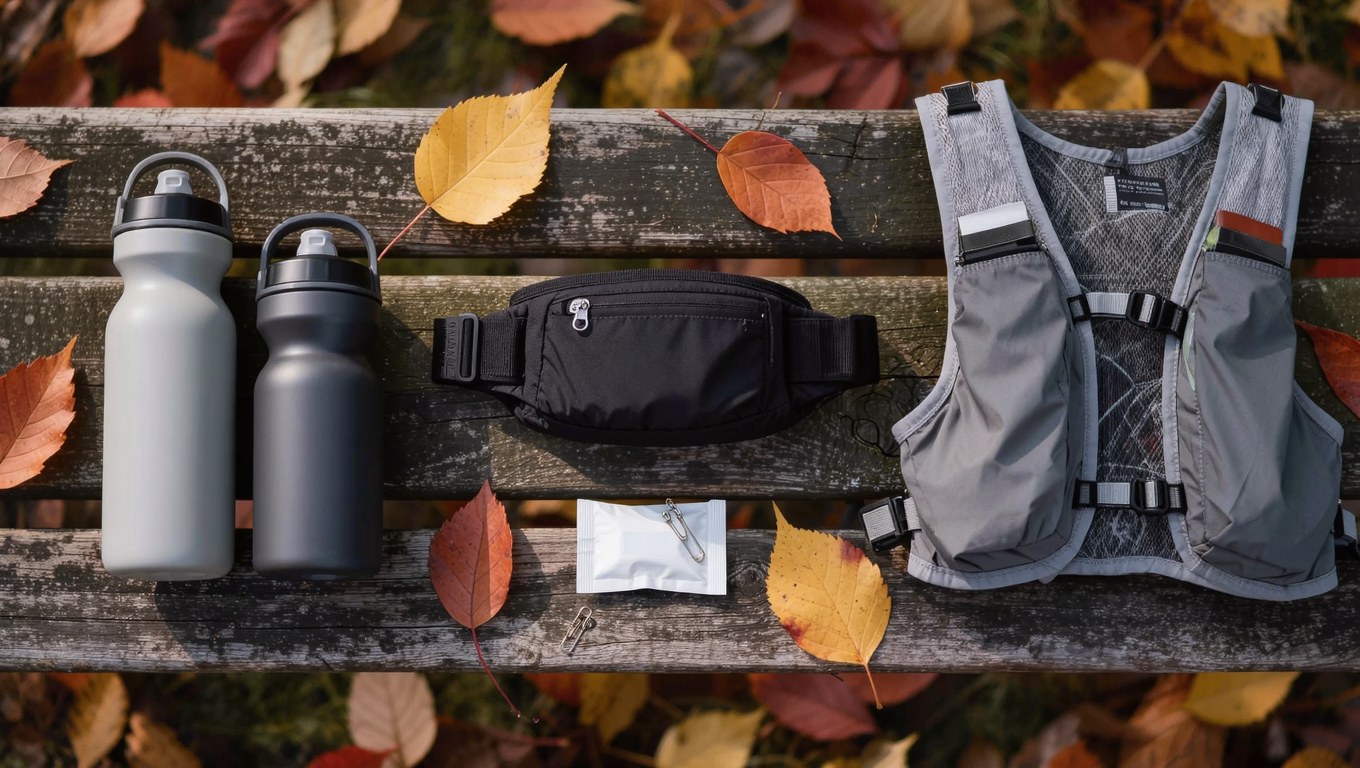
The short version — Most fall marathons let you carry a fuel belt, a handheld bottle or a vest with soft flasks on the front. The two big exceptions are Chicago (Oct. 11) and New York (Nov. 1), which ban hydration packs and vests with a bladder in the back. Marine Corps (Oct. 25) goes the other way and allows a CamelBak outright. If a race has 14 or more aid stations and you finish under about 4:30, a belt with one or two flasks is usually all you need.
For a race, the belt-or-vest question is settled by the rule sheet first, then by the gaps between water tables, and only then by bounce. We read the 2026 participant pages for seven fall marathons and priced the gear on each brand's own U.S. store.
Which fall marathons allow hydration vests in 2026?
| Race (2026) | Start | Back bladder / pack | Belt, handheld, front-flask vest | Aid stations |
|---|---|---|---|---|
| Twin Cities, Sun. Oct. 4 | 8:00 a.m. CT | Water vests permitted | Belts and handhelds not addressed | 14, Nuun Endurance |
| Wineglass, Sun. Oct. 4 | 8:15 a.m. ET | Packs and vests allowed, subject to search | Not addressed | Count not posted for 2026 |
| Chicago, Sun. Oct. 11 | 7:30 a.m. CT (elite) | Not permitted | Allowed | 20, Gatorade Endurance |
| Detroit, Sun. Oct. 18 | 7:00 a.m. ET | Allowed; big packs may be searched at the border crossing | Allowed | 19, Gatorade Endurance |
| Marine Corps, Sun. Oct. 25 | 7:20 a.m. ET | Allowed, including CamelBak | Allowed | 12 water points, Nuun Endurance |
| New York, Sun. Nov. 1 | Waves from 9:10 a.m. ET | Not permitted | Allowed if bottles are 1 liter or less | About 20, Gatorade Endurance |
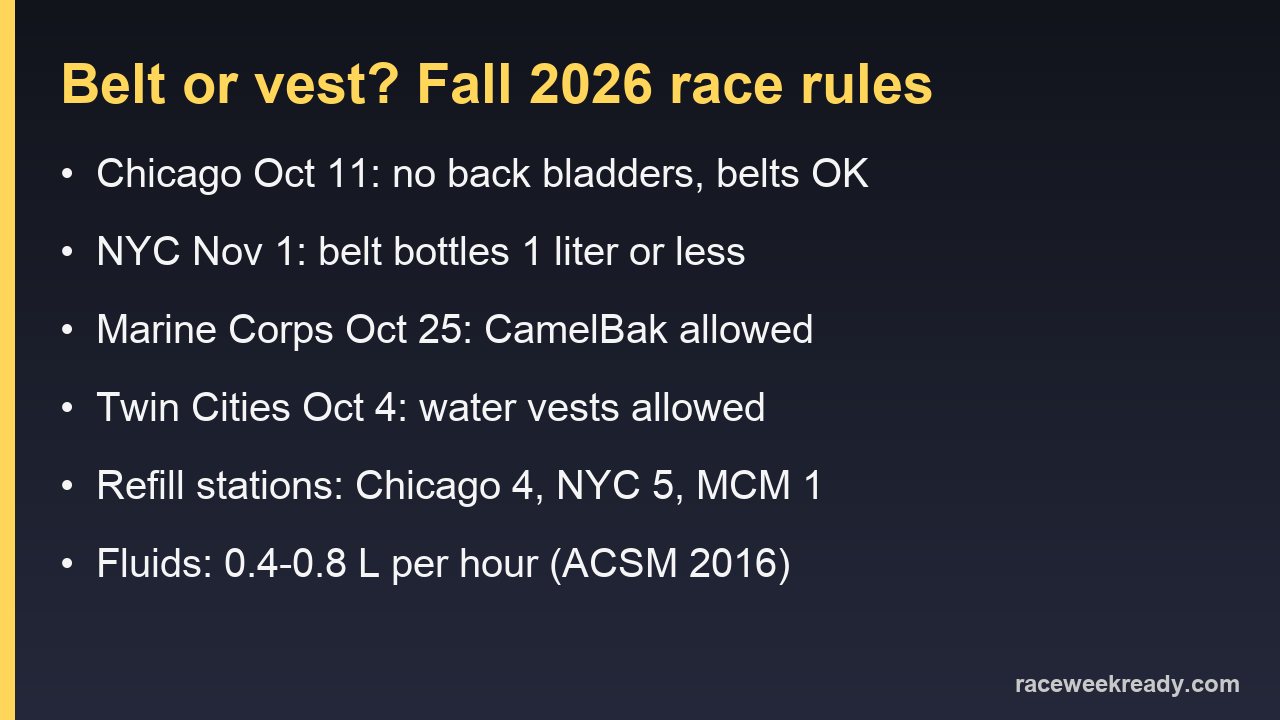
Chicago's rule is not a blanket vest ban. It bans CamelBaks and "any type of hydration backpack," but allows front-pocket vests, fuel belts, handhelds and soft flasks. Water on your chest is fine; water on your spine is not.
New York uses the same line plus a size cap: no single container over 1 liter. Two 500 mL flasks pass; a 1.5-liter bladder does not.
St. George (Saturday, Oct. 3) posts no carry rule, so email the race before packing a vest. Our St. George race page covers the start and the 2,560-foot drop.
How far apart are the water tables, really?
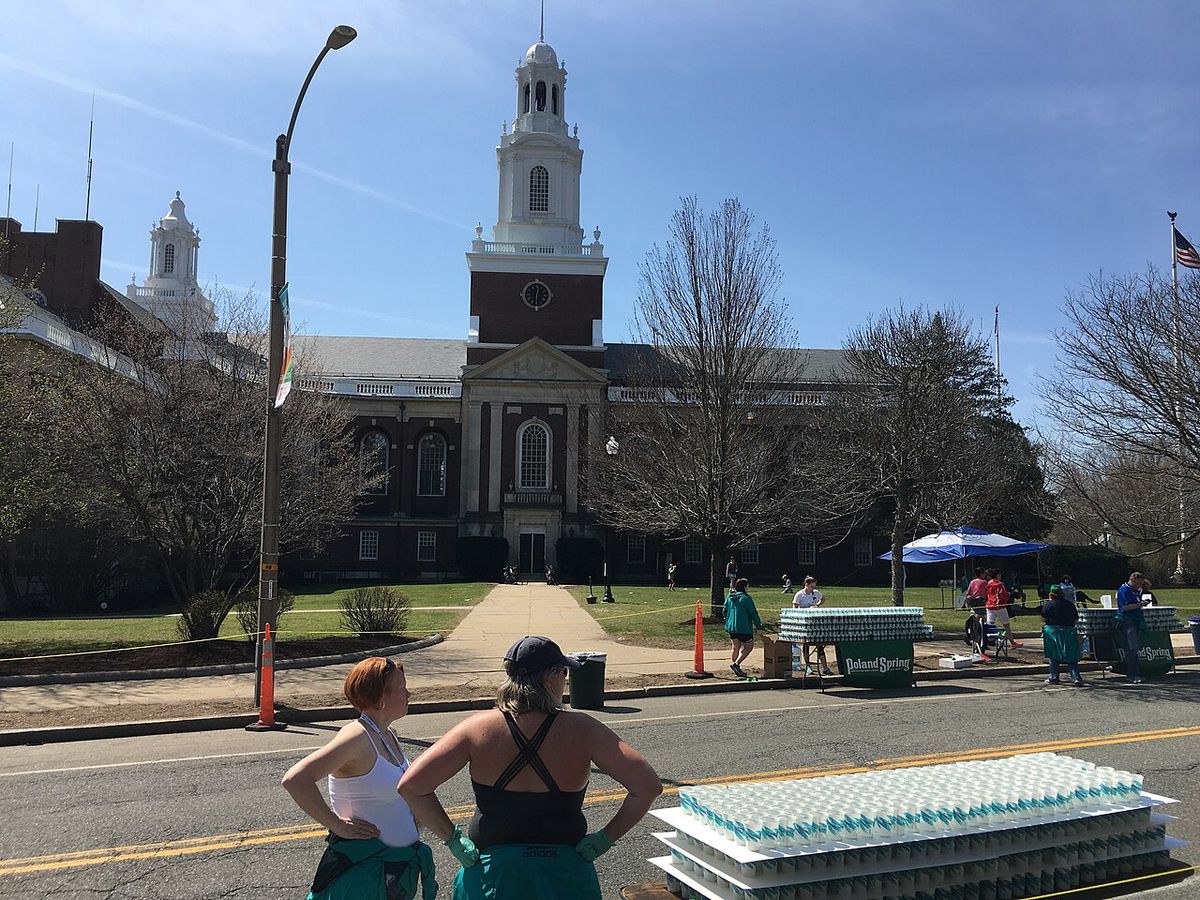
Chicago runs 20 stations about every 1 to 2 miles. St. George has 15 on the course, spaced about 2 miles apart early and about every mile from mile 17 on. Twin Cities lists 14, which is the thinnest of the big October races.
Three races now add cupless self-serve refills, and those are what make a small belt so useful:
- Chicago: Culligan refill stations at miles 5.7, 10.1, 15.7 and 20.3.
- New York: refill stations at miles 8, 14, 17, 20 and 23.
- Marine Corps: one self-serve station on the 14th Street Bridge.
Two soft flasks let you drink on your own schedule and top up without fighting a crowded cup table. For a 4-hour runner in Chicago, that is a refill every 40 to 50 minutes.
How much do you actually need to drink per hour?
The 2016 joint position stand from the American College of Sports Medicine and two dietetics groups puts a typical fluid plan at 0.4 to 0.8 liters per hour, adjusted to what your stomach tolerates. For carbohydrate it gives 30 to 60 grams per hour for efforts of 1 to 2.5 hours, and up to 90 grams per hour for longer ones.
Now do the arithmetic for a 4:15 finish at the low end of the fluid range. That is about 1.7 liters across the whole race. At 20 aid stations, if you get about 120 mL (4 oz) down at each table, that is 2.4 liters. In Chicago or New York you can race on course support alone, and a belt is mainly there for gels and your phone.
Twin Cities, with 14 stations, gives you fewer chances to drink. At the same 120 mL a table you are at about 1.7 liters, right on the minimum. That is where a single 500 mL flask earns its place.
Which running belts hold a phone, gels and a flask?
| Belt | List price | Weight | What fits | Sizing |
|---|---|---|---|---|
| SPIbelt Original | $29.99 | 82 g | One stretch pocket, 9 x 4 x 2 in. | Adjusts 25–38 in. |
| Salomon Pulse | $35 | 62 g | 0.79 L; side pockets take a 500 mL flask | XS–XL |
| FlipBelt Classic | $44 | 3.8 oz | Tube with several openings, key hook | 7 waist sizes, XXS–XXL |
| Naked Running Band | $55 | 2.3 oz | Up to three 500 mL flasks | 12 waist sizes, 28–39 in. |
| Nathan TrailMix Plus 3.0 | $60 | Not listed | Two 10 oz flasks included, zip pocket | One size |
The SPIbelt and FlipBelt are phone-and-gel belts; neither comes with a flask, and a full 500 mL bottle in a single pouch will swing. The Naked band and the Salomon Pulse are built to take flasks. The Nathan is the only one here that ships with bottles in the box, and two of its colors were marked down to $45 when we checked.
FlipBelt tells you to size up, and Naked says its size has nothing to do with your pant size, so measure where the belt will actually sit.
At the budget end, Bubblelime's buckle-free running waist belt lists at $13.98 in navy, in S to L, with reflective trim. It is a pocket belt for a phone and gels, not a flask carrier, so treat it as the SPIbelt's job at half the price, not the Naked band's.
Which race vests pass the front-flask rule?
| Vest | List price | Capacity | Flasks included | Weight |
|---|---|---|---|---|
| Osprey Duro LT (men's; Dyna LT is the women's cut) | $110 | 0.5 L | Two 500 mL | 150–170 g |
| Osprey Duro 1.5 (men's) | $130 | 1.5 L | Two 500 mL | 200–220 g |
| Salomon ADV Skin 5 | $145 | 5 L | Two 500 mL | 203 g (281 g with flasks) |
| Ultimate Direction Race Vest 6L | $154.95 | 6 L, 9 outside pockets | Two 500 mL | 175 g |
| Nathan Pinnacle Pro 6L | $200 | 6 L, 9 pockets | Two 20 oz | 232 g (337 g with flasks) |
All five carry their water on the chest, so all five fit Chicago's and New York's wording as long as you leave the back sleeve empty. The 5- and 6-liter vests are trail gear; on a road course that space mostly carries a jacket you will not wear.
Belt or vest: myth vs fact
- Myth: a vest is always cooler because nothing is on your waist. Fact: a vest covers a big patch of chest and upper back that would otherwise be shedding heat. On a warm day, like the 78 to 81 degrees Wineglass hit around 1 p.m. last October, a belt is the cooler choice.
- Myth: bounce means the belt is the wrong size. Fact: bounce often comes from where the weight sits. Two small flasks, one on each hip, tend to bounce less than one big one in the middle.
- Myth: you must carry your own drink to take gels. Fact: Chicago hands out Maurten gels at miles 12.4 and 18.1, and New York at miles 12 and 18. Carry your own if your stomach knows only one brand.
What should you test on your next long run?
Run at least 10 miles in the exact setup, with full flasks, the gels you will race with and your phone. Then check your lower back, collarbones and inner upper arms for rubbing.
Wear the shorts or tights you will race in, too. A belt over high-waist running tights with pockets sits differently than it does over split shorts, and a waistband seam under a belt is a common rub point by mile 18. Our kit-by-temperature chart helps you pick the layer before you pick the belt.
Our fall training countdown shows which races are already in taper, and the shoe rotation page covers the other gear that should not be new on race day. If you start before sunrise, the dark-miles gear notes cover lights and reflective bands that clip to a belt.
Which October races are close enough to plan around now?
Twin Cities and Wineglass share Oct. 4. The Twin Cities page has its corral times and past race-morning weather. The Wineglass page covers the bus windows; the race FAQ says backpacks cannot ride the start buses, and vests are subject to search. The Quad Cities weekend and the marathons index round out the fall calendar, and the night-before checklist has a line for filling your flasks. More carry gear is in the gear section.
FAQ
Can you wear a hydration vest in the Chicago Marathon?
Yes, if it carries water in front pockets or soft flasks. Hydration backpacks, CamelBaks and vests with a bladder in the back are not permitted. Fuel belts and handheld bottles are allowed.
Is a running belt allowed in the NYC Marathon?
Yes. New York allows a fuel belt with bottles of 1 liter or less, and front-pocket vests under the same limit. Back bladders are banned.
Sources
- Chicago carry rules, aid stations, gels and refill points: Chicago Marathon course amenities and event rules, read Sept. 23, 2026.
- New York: NYRR prohibited items and the course. Marine Corps: safety and race day pages.
- Twin Cities: Twin Cities Marathon Weekend FAQ. Detroit: Free Press Marathon FAQ. Wineglass: race FAQ. St. George: marathon information.
- Fluid and carbohydrate ranges: ACSM, Academy of Nutrition and Dietetics and Dietitians of Canada, Nutrition and Athletic Performance (2016).
- Prices, weights and capacities: each brand's own U.S. online store (FlipBelt, SPIbelt, Naked, Nathan, Salomon, Osprey, Ultimate Direction, Bubblelime), checked Sept. 23, 2026. List prices shown.