St. George Marathon 2026: What Time Does It Start and How Cold Is the Start Line?

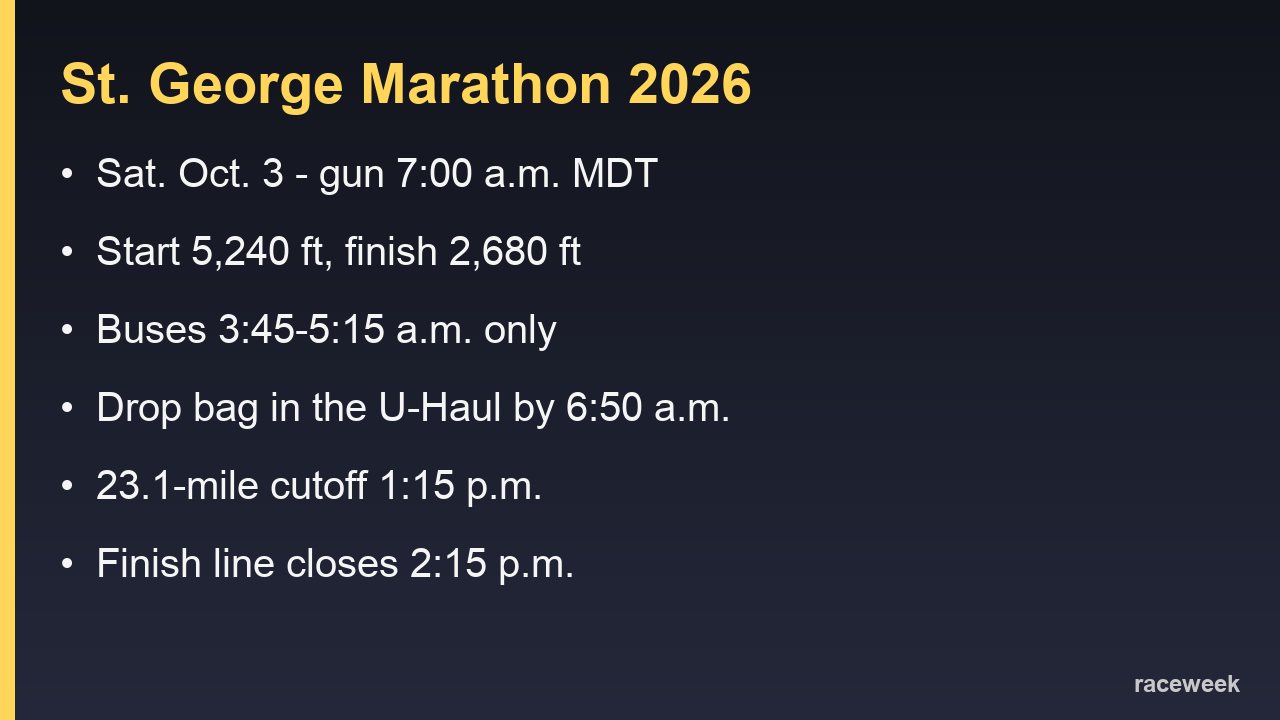
Where this stands — The St. George Marathon runs Saturday, Oct. 3, 2026, with a 7 a.m. MDT gun in the Pine Valley Mountains at 5,240 feet and a finish 2,560 feet lower in Vernon Worthen Park. Buses leave town between 3:45 and 5:15 a.m. and there is no other way to reach the start. Entry closed when the 6,000-runner cap filled, and the person-to-person transfer window shut on Sept. 15 — deferral to 2027 is the only door still open, through Oct. 2.
Two weeks out, the decisions that matter at St. George are not about fitness. They are about a bus you cannot miss, a bag you have to surrender at 6:50 a.m., and roughly 90 minutes of standing around in the dark at an elevation where the air is 25 degrees colder than the town you drove in from.
What time does the St. George Marathon start, and when do the buses go?
| Time (MDT) | What happens | Where |
|---|---|---|
| 3:45 – 5:15 a.m. | Marathon buses load, assigned times only | Vernon Worthen Park, 250 S 400 E |
| 3:45 – 5:15 a.m. | Half marathon buses load | Sandtown Park, 600 N Bluff |
| 6:50 a.m. | Drop bags into the U-Haul at the start | Start line, both races |
| 7:00 a.m. | Marathon and half marathon start | Pine Valley Mtns / Diamond Valley |
| 1:15 p.m. | Course cutoff at Snow Canyon Parkway & S.R. 18 | Mile 23.1 (marathon), mile 10 (half) |
| 2:00 p.m. | Drop bags leave the finish for the Rec Center | Vernon Worthen Park |
| 2:15 p.m. | Marathon finish line closes | Vernon Worthen Park |
The bus window is the hard constraint. Both races are point-to-point into country with no parking and no shuttle of your own, so a runner who sleeps through a 4:30 boarding time does not start. Back the alarm up from the far end of your assigned window, not from the gun.
How much elevation does this course actually give back?
The start sits at 5,240 feet in the Pine Valley Mountains and the finish is at 2,680 feet in town, a net drop of about 2,560 feet across 26.2 miles. That is the headline, and it is why the race is a fixture on Boston-qualifying lists.
It is not a straight ramp. Runners' files and the published course profile put a genuine climb at miles 7 through 8 — the Veyo hill, close to a mile of uninterrupted uphill — inside a course with roughly 500 feet of total gain. Everything after it runs downhill past the red sandstone and black basalt near Snow Canyon toward town.
The cost lands later. A long descent loads the quadriceps eccentrically for two hours, and people who have only trained on flat ground arrive at mile 20 with legs that will not hold pace even though their breathing is fine. Our fall build-up notes and the shoe rotation page both come back to the same idea: the downhill has to be rehearsed in the shoes you will race in, not discovered on the day.
How cold is it really at that start line?
| Year | Oct. 3, ~6:56 a.m. in town | Dew point | Wind |
|---|---|---|---|
| 2025 | 68°F | 45°F | 9 kt ESE |
| 2024 | 64°F | 24°F | calm |
| 2023 | 49°F | 42°F | 3 kt SE |
| 2022 | 63°F | 55°F | 5 kt SSE |
| 2021 | 57°F | 28°F | 4 kt S |
Those are readings from the St. George airport, 300 feet above the finish line and 2,560 feet below the start. Five Octobers, a 19-degree spread, and none of them describe what you will feel while you wait.
The race's own long-run history puts start-line mornings between 38 and 44°F with finish-line afternoons of 65 to 85°F. NOAA's 1991–2020 normals for Oct. 3 in St. George read 84°F for the high and 55°F for the low, so a runner can reasonably expect to begin in the 40s and finish in air 30 to 40 degrees warmer. That single fact drives every clothing decision below.
What should you wear for a 7 a.m. gun at 5,240 feet?
Dress for mile 3, then solve the 90 minutes before it separately. The standing-around layer should be something you are willing to abandon at the line — old sweats, a throwaway fleece, a cheap mylar sheet, gloves you will not miss. Races of this shape generate mountains of discarded clothing at the gun, and it gets collected and donated.
For the race itself, a 40-degree start that becomes a 70-degree finish argues for a singlet or short sleeves plus arm sleeves you can push down, with a thin pair of gloves as the cheapest insurance in running. Full-length tights are the common mistake: they feel right at 6:45 a.m. and are wrong by mile 10, and on a downhill course the extra fabric on a warm second half costs more than the early comfort it buys. If you want something on the leg, a capri or 7/8 length behaves better across that temperature swing — the sizing people get wrong here is inseam rather than waist, which our colleagues at leggingsizeguide.com break down by height.
Our temperature-by-temperature kit chart covers the rest, and the night-before checklist is worth a read on Oct. 2 if this is your first point-to-point race.
Can you still get into the 2026 race?
No. Registration opened April 1 at 6 a.m. MDT and closed on capacity: 6,000 marathon entries, 3,000 half marathon, 500 for the 5K. Prices ran $150 in April, $165 through June and $180 from July 1, and the half ran $115 to $145 on the same ladder.
Person-to-person transfers ended Sept. 15, and buying a bib off someone privately is the worst idea on this page — the race disqualifies both parties and bans them for a minimum of two years. There is no waiting list published for the 2026 edition.
What if you are registered and now cannot run?
Defer. The window runs through Oct. 2 at a $50 fee, down from $25 before Sept. 1, and the credit is good for one use within two years. That is a better outcome than a did-not-start, and it is the only sanctioned way to move your entry at this point.
What are the cutoffs you have to beat?
One checkpoint decides your day: Snow Canyon Parkway and S.R. 18, at mile 23.1, by 1:15 p.m. That is 6 hours 15 minutes of race time, an average of 16:13 per mile. Half marathoners face the same clock at their 10-mile mark. Miss it and you are removed from the course and driven to the finish. The marathon line itself closes at 2:15 p.m.
Anyone on the edge of that pace should look hard at the afternoon temperature column above before choosing a start-line outfit, because the last three miles are the warmest part of the day.
Where do you pick up your packet?
The expo runs Friday, Oct. 2, from 10 a.m. to 8 p.m. at the Dixie Convention Center, 1835 S Convention Center Dr. Bags left at the start go in a U-Haul with your bib sticker on the bottom and come back to the finish until 2 p.m.; after that they move to the St. George Recreation Center for Saturday and Sunday pickup.
How does St. George compare with the other fall races on the board?
It is the biggest thing on the calendar between now and Chicago — 4,376 people finished the marathon in 2025 and 7,895 ran across all distances, which makes it the 16th largest marathon in the country. The current course records, both set in 2025, stand at 2:13:56 for Jake Heslington and 2:28:41 for Kodi Kleven.
For contrast, the Erie Marathon sells its flatness and the Akron half sells its climbs; St. George sells altitude you spend rather than earn. The rest of the fall calendar sits on our marathons index, the shorter fields on the half and 5K page, and this weekend's starts on the Sept. 19–20 board.
TL;DR — Oct. 3, 7 a.m. MDT, 5,240 feet down to 2,680 over 26.2 miles with a mile of climbing at Veyo. Buses 3:45–5:15 a.m. or you do not start; bags in by 6:50; mile 23.1 by 1:15 p.m.; finish closes 2:15. Entry is gone and transfers closed Sept. 15, but deferral is open to Oct. 2. Expect the 40s at the gun and the 70s at the finish, and dress for the second number. Conditions we have logged for other race mornings sit on our weather page.
Sources
- Start time, bus windows, drop-bag deadline, cutoff and finish-line close: City of St. George marathon information and half marathon information, retrieved Sept. 19, 2026.
- Entry caps, opening date, fees, transfer deadline and deferral fees: registration policies, retrieved Sept. 19, 2026.
- Date and distances cross-checked against MarathonGuide and RunGuides.
- Start and finish elevation, field size, course records, history and typical race-morning temperatures: Wikipedia race article.
- Oct. 3 observations: St. George Regional Airport (SGU) records at 6:56 a.m. MDT via the Iowa Environmental Mesonet. Climate normals for Oct. 3: NOAA NCEI 1991–2020 daily normals, station USC00427516.
- Steamtown Marathon 2026: The 955-Foot Drop, Cooper's Hill and Race-Morning Weather
- Milwaukee Lakefront Marathon 2026: Two Hoan Bridge Crossings, Cutoffs and Race-Day Heat
- Portland Marathon 2026: Four Bridges, the 6:33 Cutoff and What Race Morning Feels Like
- Maine Marathon 2026: Start Time, the Hills to Yarmouth and How Warm the Finish Gets